

3 min read
Quick Answer
Anthropic’s March 2026 labor market research shows AI is actively performing professional tasks at scale. Programming (75% task coverage), customer service, and financial analysis are the most exposed occupations today. McKinsey reports 88% of organizations use AI, but only 6% see real enterprise value. The tipping point isn’t adoption, it’s transformation.
This Isn’t a Forecast.
Here’s the thing about most AI predictions: they’re guesses dressed up in data. Anthropic’s latest research (Labor Market Impacts of AI, March 2026) takes a different approach. Instead of asking what AI could do, they measured what it’s actually doing in real professional settings, weighted toward automated and work-related use.
The results are specific enough to act on. And if you run a software company, several of them probably hit close to home.
What the Data Actually Shows
The research introduces a metric called observed exposure, the share of an occupation’s tasks where AI is already being used professionally, not just where it theoretically could be. Here’s how the most-exposed roles stack up:
| Occupation | AI Task Coverage (Observed) | BLS Job Growth Outlook (2024–2034) |
| Computer Programmers | 75% | -6% (declining) |
| Customer Service Reps | High (API-driven) | Flat to declining |
| Data Entry Keyers | 67% | Declining |
| Financial Analysts | High | +6% (but watch the gap) |
Sources: Anthropic, March 2026; BLS Employment Projections, 2024–2034.
The pattern is hard to miss. Programming is at 75% coverage and the BLS already projects decline. Customer service is being automated through API integrations, not chatbots on a website, but AI embedded directly into company workflows. Financial analysis maps almost perfectly onto what LLMs do best: retrieve data, model scenarios, and summarize findings.
The key number: For every 10-percentage-point increase in AI task coverage, BLS-projected job growth drops by 0.6 points. Modest, but consistent. And this only measures one AI provider’s platform. (Anthropic, March 2026)
Q: Has this actually caused layoffs yet?
A: Not in the aggregate data, but it’s showing up in hiring. Workers ages 22–25 are 14% less likely to land jobs in exposed occupations compared to 2022. Displacement looks like a hiring freeze before it looks like a pink slip.
Which Industries Are Closest?
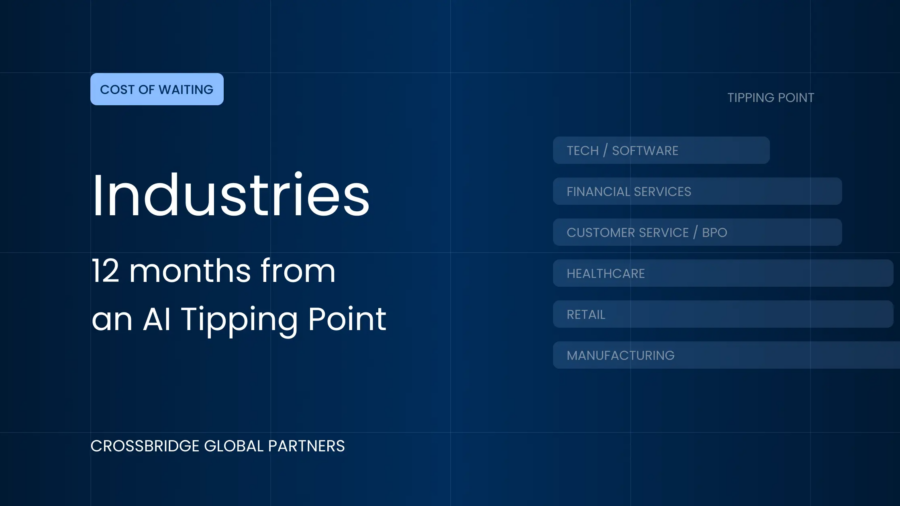
Zooming out from occupations to industries, here’s where things stand:
| Industry | Status | Tipping Point |
| Tech / Software | Already shifting. 75% programmer coverage. | Now |
| Financial Services | $20B+ annual AI spend. 68% of hedge funds use AI. | 6–12 months |
| Customer Service / BPO | API-driven automation outpacing chatbot era. | 6–12 months |
| Healthcare | Fastest CAGR (36.8%), but only 1% fully mature. | 12–24 months |
| Retail | 3.7x average ROI on gen AI. Support going AI-first. | 12–18 months |
| Manufacturing | 51% using AI. 3x more likely to hit KPI targets. | 18–24 months |
Sources: McKinsey State of AI 2025; Gartner 2025; NAM 2025; Anthropic 2026.
Meanwhile, McKinsey’s 2025 survey of nearly 2,000 executives found that 88% of organizations use AI in at least one function. But only 6% report enterprise-wide financial impact. That gap is the whole story. The tipping point isn’t when everyone adopts AI. It’s when a few competitors extract transformational value—and the rest can’t close the distance.
What This Means for You
The value is moving from code to systems. Programmer roles are contracting. Software developer roles (architecture, design, integration) are projected to grow 15%. The talent you need is changing.
Customer-facing functions are automating first. If your competitors embed AI into their customer experience before you do, they don’t just cut costs—they reset the standard.
Adoption is table stakes. Transformation is the differentiator. McKinsey’s high performers are 3x more likely to pursue transformative AI use cases. The strongest predictor of enterprise AI value? Workflow redesign—not tool selection.
Q: Does this mean nearshore teams are at risk?
A: Depends on what they’re doing. Rote programming? Yes. Systems design, architecture, and AI integration? Those are on the growth side. The question isn’t whether to use nearshore talent—it’s whether your partners are staffing for the roles AI can’t replace.
Key Takeaways
- AI displacement is measurable now. Programmers (75%), data entry (67%), and customer service are the most exposed occupations today.
- BLS projects programmer employment will decline 6% through 2034. Software developers grow 15%. Staff accordingly.
- 88% adopted, 6% transformed. The competitive gap is in workflow redesign, not tool adoption.
- Financial services and customer service/BPO are 6–12 months from structural shifts. Healthcare and manufacturing, 12–24 months.
- Young workers are already feeling it: 14% drop in job-finding rates in exposed occupations since 2022.
The window is open, but it’s narrowing. Want to see how Crossbridge builds AI-savy engineering teams ready to deliver? Talk with our experts