

4 min read
Your Board Doesn’t Want a Technology Briefing
They want to know three things: Are we behind? What does catching up cost? And how will we know if it’s working?
Most CTO presentations answer none of these questions clearly. They lead with architectural decisions and model comparisons that mean nothing to a CFO and bury the business impact in a footnote. The result is a board that nods, approves a vague mandate, and then asks uncomfortable questions at the next quarterly review.
The fix isn’t simplifying the technology. It’s reframing the conversation around the decisions the board currently needs to make.
Why Board AI Presentations Usually Miss
CTOs are trained to think in systems. Boards are trained to think in risks and returns. These are different cognitive frameworks, and most AI presentations are built for the trainer when they need to speak to the speaker.
The second problem is credibility without specificity. Saying ‘AI will transform our customer experience’ sounds like a press release. Saying ‘automating our tier-1 routing support will reduce average handling time from 8 minutes to 3 minutes, saving $340K annually at current volume’ is a business case. Boards fund business cases.
What Effective Board AI Briefs Include
According to PwC’s 2025 Board Governance and AI Survey, 71% of board members said the AI presentations they found most useful focused on competitive positioning and risk exposure rather than technology capabilities. Only 18% said technical architectural details were important for board-level decisions.
PwC 2025: 71% of board members say the most useful AI briefings focus on competitive positioning and risk, not technology architecture.
The Deloitte 2025 CEO and Board AI Readiness Report found that boards are most concerned about three AI risks: regulatory exposure, reputational risk from AI errors, and the competitive cost of delayed adoption. Structuring your presentation around these three concerns and showing how your strategy addresses each converts a technology briefing into a risk management conversation.
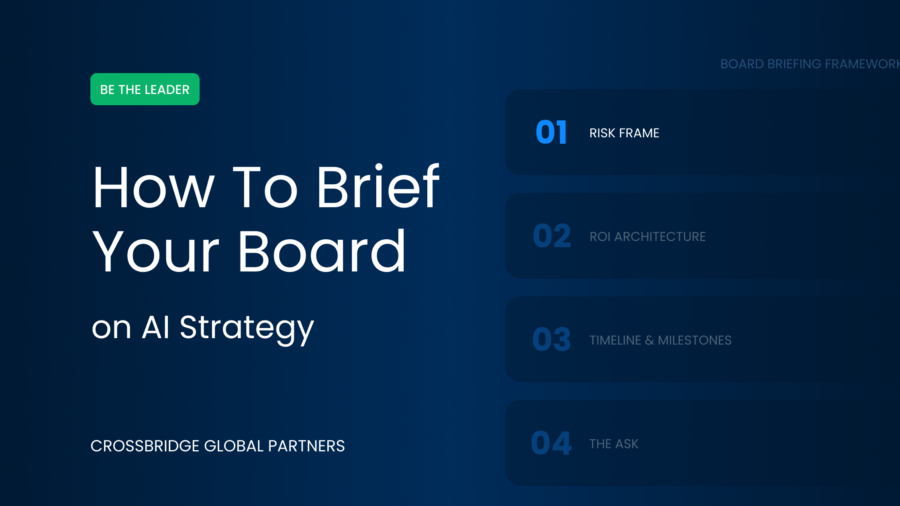
The most effective framework:
- (1) Where we are relative to competitors and the market.
- (2) What we’re doing, in plain language.
- (3) What it costs and what it returns.
- (4) What success looks like in 12 months.
- (5) What you’re asking the board to approve.
How to Make It Stick
Use one analogy for an unfamiliar concept. If you need to explain LLMs, don’t explain transformers, say ‘it’s a very fast, very well-read research assistant that never gets tired, works in milliseconds, and costs $0.02 per task instead of $40.’ Boards can price that.
Anchor every capability claim to a real number from your business. Not ‘AI can reduce churn.’But if we reduce churn by 1 point from current rates, that’s $2.1M in retained revenue annually. This project targets a 0.8-point reduction.’ That’s a foundational conversation.
End with a clear ask.Not ‘we need support for our AI initiative.’But ‘we’re requesting approval to staff a three-person AI delivery team for Q2, with a budget of $X, to ship [specific use case] by [specific date], targeting [specific metric].’Specificity is respect for the board’s time.
Key Takeaways
- Boards want to know: Are we behind? What does it cost? How will we know if it worked?—not architecture details.
- 71% of board members say the most useful AI presentations focus on competitive positioning and risk (PwC 2025).
- Structure around three board-level concerns: regulatory exposure, reputational risk, and cost of delayed adoption (Deloitte 2025).
- Translate every capability claim into a business number from your own context—generic ROI statistics don’t close budgets.
- End with a specific ask: team size, budget, timeline, use case, and success metric. Vague mandates don’t get funded.
If you want to see how Crossbridge helps CTOs build the AI delivery capacity, book your AI opportunity session today.