

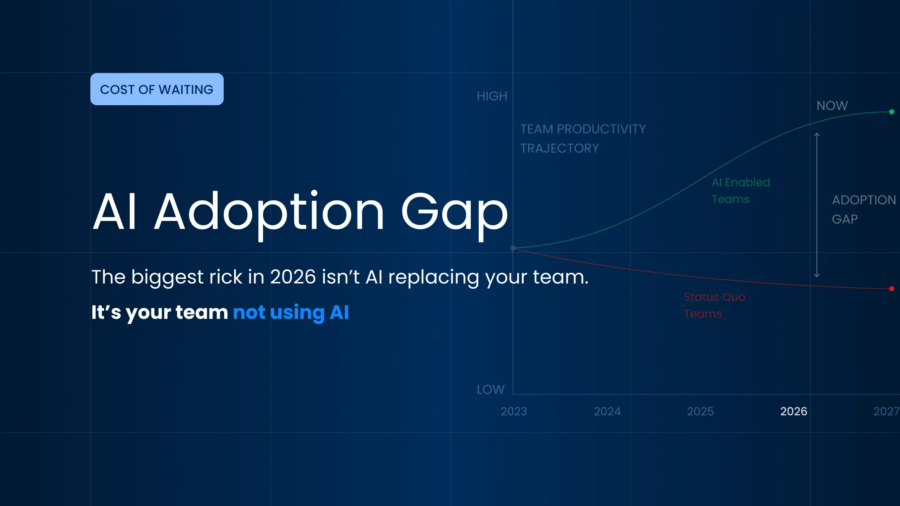
The biggest risk in 2026 isn’t AI replacing your team, it’s your team not using AI
3 min read
Quick Answer
Anthropic’s March 2026 research shows a massive gap between what AI can do and what teams are actually using it for. In computer and math roles, AI could handle 96% of tasks—but real-world adoption is just 37%. McKinsey backs this up: 88% of organizations use AI, yet only 6% capture real value from it. The edge doesn’t come from having AI. It comes from deploying it.
The Gap No One’s Talking About
If your team builds software, AI can theoretically perform 96% of the tasks in your domain. But actual adoption is just 37%, Anthropic’s research, March 2026.
That’s a deployment gap; 59 percentage points of untapped capability, sitting right there.
Why This Gap Exists
Most organizations aren’t ignoring AI—they’re stuck in pilot mode. McKinsey’s 2025 State of AI report tells the story: 88% of organizations use AI somewhere, but only a third have scaled it across the enterprise. Just 6% see meaningful financial returns.
The barriers aren’t technical. They’re structural: fragmented data, unclear workflows, and not enough people who know how to wire AI into real engineering processes—not just play with it.
Q: Tools are everywhere. Why aren’t teams using them?
A: Access isn’t the problem—integration is. A ChatGPT subscription isn’t the same as AI embedded in code review, testing, deployment, and documentation. The teams seeing real returns are redesigning how work gets done, not bolting AI onto old processes.
What the Data Says
Anthropic’s study (Massenkoff & McCrory, March 2026) introduces “observed exposure”, a metric tracking what AI is actually doing in professional settings versus what it could do. The gap is wide across every white-collar category:
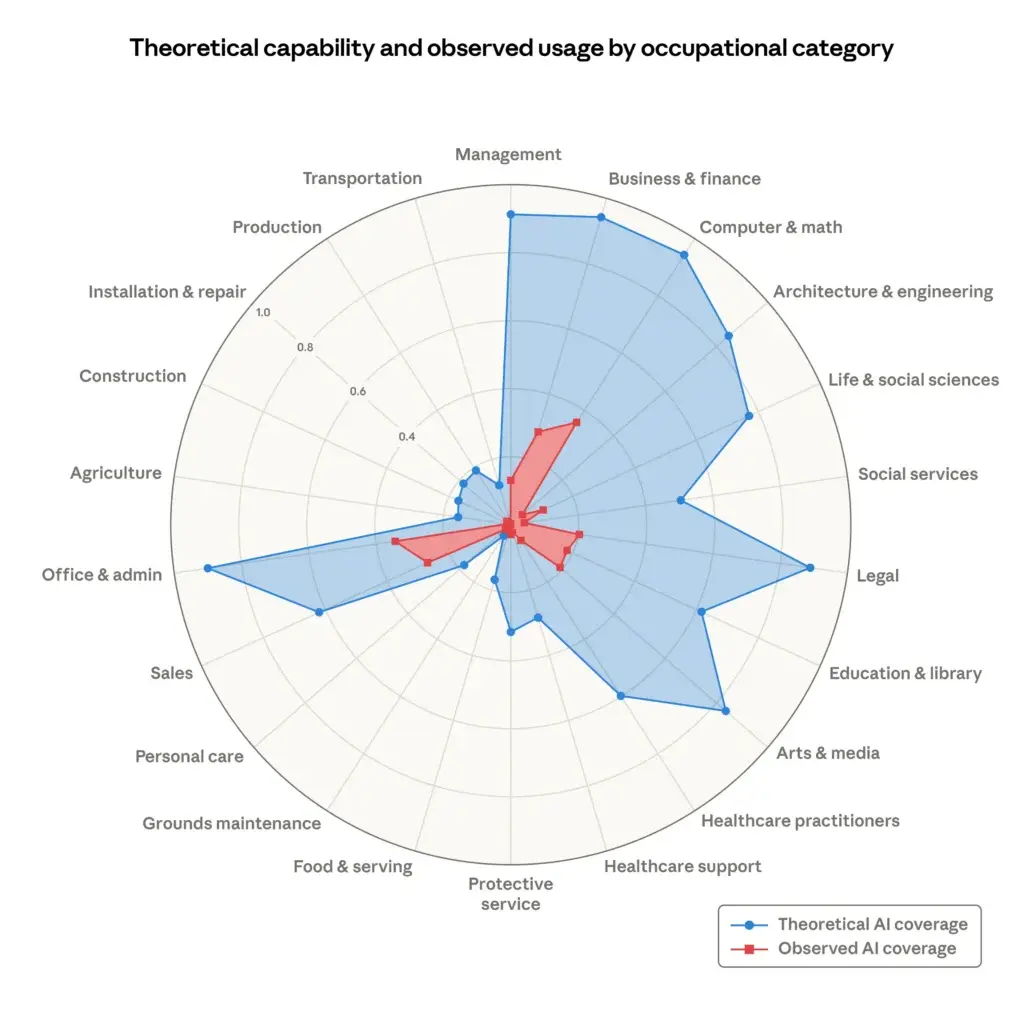
Theoretical capability and observed exposure by occupational category
Share of job tasks that LLMs could theoretically perform (blue area) and our own job coverage measure derived from usage data (red area). Source: Anthropic, “Labor market impacts of AI,” March 2026 (anthropic.com/research/labor-market-impacts)
| Category | Theoretical Coverage | Actual Usage | Gap |
| Computer & Math | 96% | 37% | 59 pts |
| Business & Finance | 94% | 28% | 66 pts |
| Office & Admin | 94% | 38% | 56 pts |
| Management | 92% | 16% | 76 pts |
| Legal | 88% | 20% | 68 pts |
| Sales | 72% | 22% | 50 pts |
Notice the Management row: 92% theoretical, 16% actual. That’s a 76-point gap—the widest in the dataset. If you’re wondering where AI could make the fastest impact, it might not be in the codebase. It’s in the operational workflows around it.
Q: So are mass layoffs coming?
A: Not yet. Anthropic found no systematic spike in unemployment for exposed roles since late 2022. But early signals are there: hiring for workers aged 22–25 has slowed in AI-exposed occupations. The paper explicitly names a “Great Recession for white-collar workers” as plausible if adoption accelerates sharply. The time to prepare your team is before that shift, not after.
What This Means for You
Here’s the reframe: the risk isn’t that AI replaces your engineering team tomorrow. It’s that your competitors close this adoption gap while you’re still running pilots.
Three moves to make now
1. Audit actual utilization, not tool spend. Most companies track seats purchased. Few track workflows changed. Map your team’s tasks against the gap data above. Where’s the delta?
2. Target the widest gaps, not the obvious ones. Everyone’s using AI for code generation. Fewer are applying it to code review, testing, incident response, or technical project management. That 76-point management gap is a signal.
3. Staff for integration, not experimentation. McKinsey’s high performers share a common trait: they redesign workflows around AI. That takes engineers who understand both the AI toolchain and production environments. Nearshore teams with AI experience give you the bench strength to run the full integration effort—not just a proof of concept.
Where to Start
| Signal | Action | Expected Impact |
| AI used for code gen only | Expand to testing, review, docs | 30–50% broader coverage |
| Tools purchased, usage unknown | Run a 2-week utilization audit | Surfaces top 3 workflow gaps |
| No AI in project management | Pilot AI-assisted sprint planning | Cuts coordination overhead |
| Hiring slow or over budget | Staff AI-experienced nearshore engineers | Faster integration, lower cost |
Key Takeaways
- AI capability far outpaces adoption, 59 percentage points in computer/math roles alone (Anthropic, March 2026).
- 88% of organizations use AI, but only 6% see real enterprise value (McKinsey, 2025). The bottleneck is integration.
- No unemployment spike yet, but entry-level hiring in exposed roles is already slowing. The window to prepare is closing.
- The widest gap is in management workflows (76 points). Operational AI integration is the next frontier.
- Closing the gap takes AI-experienced engineers who move from pilot to production. Nearshore teams deliver that experience at sustainable costs.
Close the Gap
We’ve been in the trenches of tech staffing and engineering delivery for over a decade. We’ve watched nearshore go from “plan B” to the default play for smart companies. We’ve seen frameworks rise and fall, hiring markets tighten and loosen, and entire technology stacks get reinvented.
And here’s what that experience tells us: The gap between what AI can do and what teams are actually doing with it is the largest we’ve ever seen between any technology’s potential and its adoption. And it’s closing fast.
We’re still in the early innings. The companies that act now are the ones that will set the pace. We’ve guided hundreds of teams through technology shifts, and we’re here to guide yours through this one.
Related Reading
• Nearshore vs. Offshore vs. In-House: What the 2026 Data Actually Shows